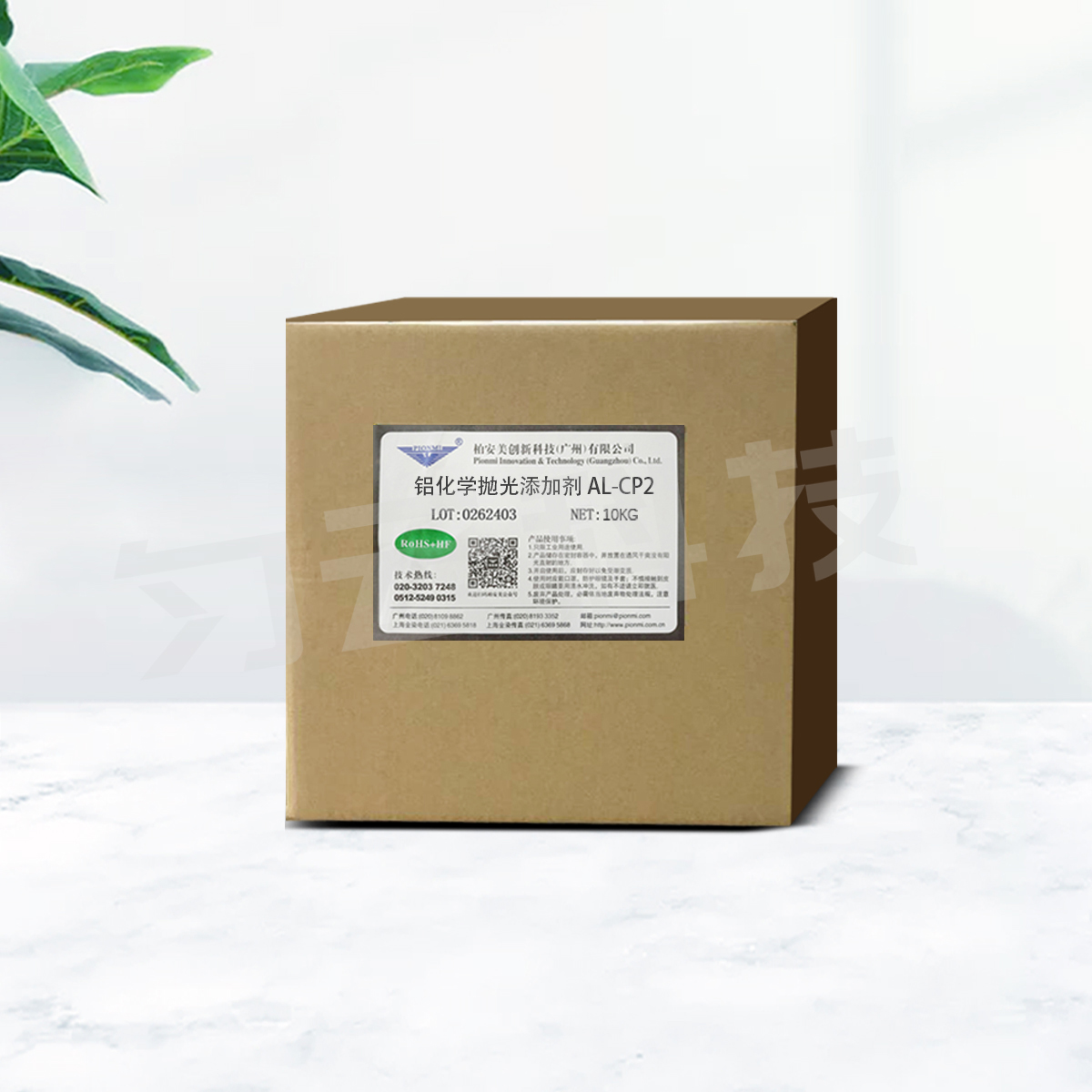
|
name said
|
oxidation Auxiliary Agent
|
|
model/specification
|
AL-CP2
|
|
characteristics
|
- Aluminum chemical polishing additive AL-CP2 has stable performance and simple operation.
- The treated aluminum or aluminum alloy has excellent brightness and is especially suitable for products with high brightness requirements.
- Reduce the release of nitrogen oxide gas and pollution.
- The solution has high stability and low production cost.
|
|
conditions of use
|
|
|
scope
|
standards
|
|
concentrated phosphoric acid
|
93%-95% (volume ratio)
|
94% (volume ratio)
|
|
concentrated nitric acid
|
5-7% (volume ratio)
|
6% (volume ratio)
|
|
AL-CP2
|
3-8 g/l
|
3-8 g/l
|
|
share of
|
1.64-1.71
|
1.68
|
|
temperatures
|
95-110℃
|
100℃
|
|
of time
|
30 seconds-3 minutes
|
|
stir
|
swing
|
|
cylinder material
|
Stainless steel SUS 316L
|
|
|
|
Process flow (aluminum or aluminum alloy):
Mechanical polishing → degreasing (degreasing powder AL-CLEAN DA5, PC-25 or special degreasing agent MC)→ sanding (AL-EN)→ stain and film removal (stain remover AL-D30)→ chemical polishing (AL-CP2)→ stain and film removal (stain remover AL-D30)→ anodic oxidation (sulfuric acid)→ dyeing → hole sealing (high temperature sealing agent SH-900 or room temperature sealing agent PLS)→ hot pure water washing → drying
Supplementary methods:
- Adjustable specific gravity of phosphoric acid
- After determining the replenishment amount of phosphoric acid, nitric acid should also be added in accordance with the proportion of opening the cylinder
- When the total amount of phosphoric acid and nitric acid added is 1 liter, the polishing agent AL-CP2 3-8 g/liter should be added,(the addition amount is determined according to the actual production situation) and so on at this ratio. Add AL-CP2 powder to the phosphoric acid and nitric acid to be added, stir and dissolve before adding it to the polishing tank.
|
|
package and storage
|
10 kg/box or 25 kg/barrel, stored in a cool and dry warehouse. Direct sunlight is strictly prohibited, high temperatures and high temperatures must be closed and sealed after use.
|
|
precautions
|
- Swing is required during operation
- Stain and film removal are needed before and after polishing
- Remove excess water before polishing
|
|
|
This additive can be used in the following three types:
|
conditions of use
|
scope
|
|
concentrated phosphoric acid
|
50%-90% (volume ratio)
|
|
concentrated nitric acid
|
5-20% (volume ratio)
|
|
concentrated sulfuric acid
|
5-30% (volume ratio)
|
|
AL-CP2
|
5-10 g/l
|
|
temperatures
|
95-120℃
|
|
of time
|
30 seconds-90 seconds
|
|
Characteristics: Low production cost and good stability, but the solution temperature is relatively high and more smoke is generated.
|
|
|
|
|
conditions of use
|
scope
|
|
concentrated phosphoric acid
|
93% (volume ratio)
|
|
concentrated nitric acid
|
7% (volume ratio)
|
|
AL-CP2
|
5-10 g/l
|
|
temperatures
|
95-120℃
|
|
of time
|
1-3 minutes
|
|
Characteristics: The solution temperature is relatively high, less smoke is generated, and the polishing effect is brighter. This is one of the most commonly used methods.
|
|
|
|
|
conditions of use
|
scope
|
|
concentrated phosphoric acid
|
50%-90% (volume ratio)
|
|
concentrated sulfuric acid
|
10-50% (volume ratio)
|
|
AL-CP2
|
5-10 g/l
|
|
temperatures
|
95-120℃
|
|
of time
|
10 seconds-60 seconds
|
|
Features: The solution temperature is relatively high, which can produce a semi-bright effect. This is a method suitable for precision parts.
|
|